

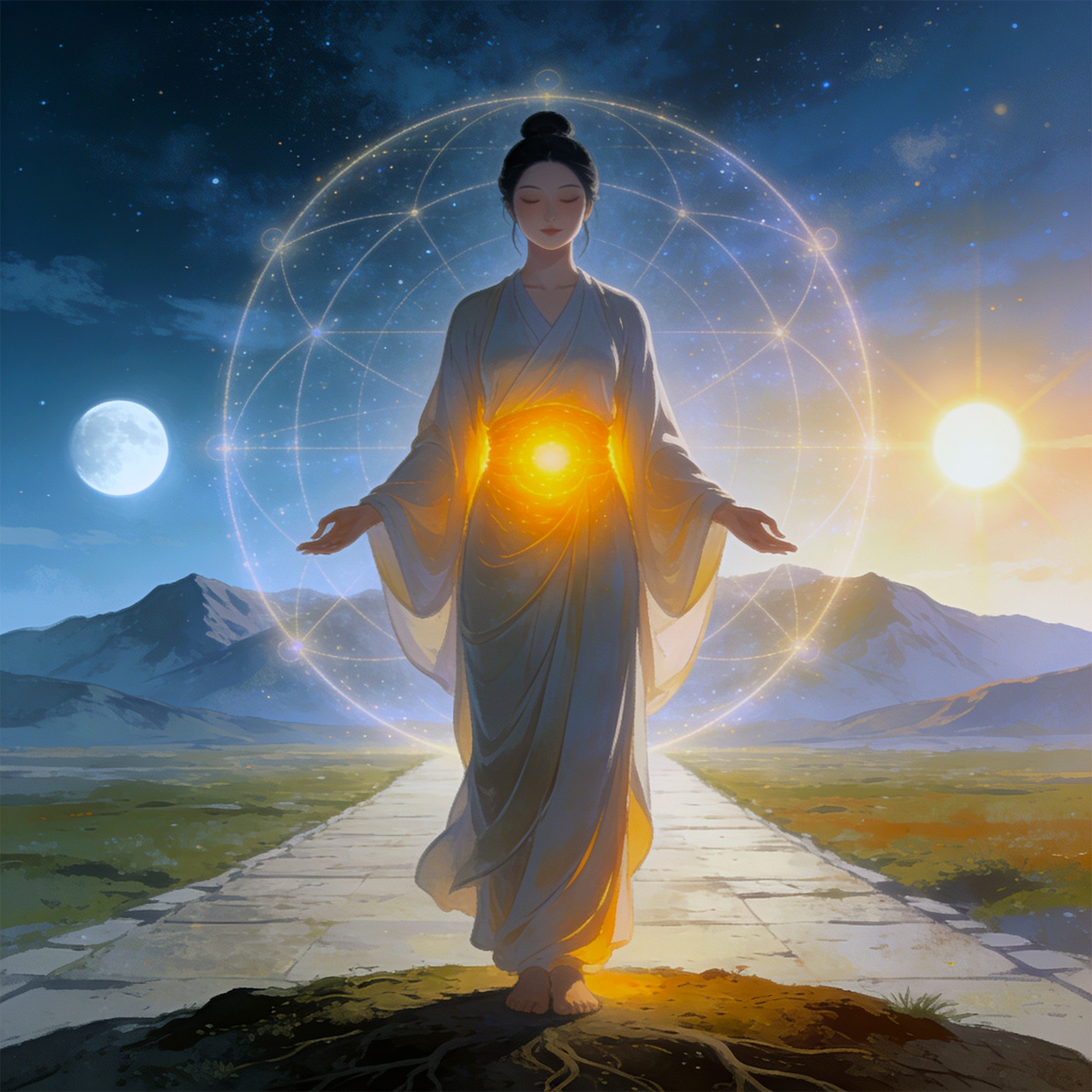
The Seven Directions Meditation
By Roshi Teja Fudo Myoo
Seven Directions — Wholeness in the Field
We do not stand at the center
because the world revolves around us.
We discover the center so that we can belong to the whole field without losing ourselves.
The Teaching: From Center-line to Center-Field
In the first weeks of this August Yǎngshēng cycle, we have been listening into the body as living tissue: fascia, fluid, breath, movement, and the intelligence that joins them. Week Four widens the lens. We move from the body as an interior landscape into the body as a center within space.
The Seven Directions practice is simple enough to understand immediately: front, back, left, right, above, below, and center. Yet when we inhabit these directions somatically, something subtle changes. Awareness is no longer only a point behind the eyes looking outward. It becomes spherical. We begin to sense that the body is not merely an object located in space. The body participates in space.
This is especially useful in Qìgōng because posture, balance, breath, and intention are always relational. The feet relate to the ground.
The crown relates to the sky. The front body meets what is arriving. The back body receives support. The two sides balance one another. At the center, the lower abdomen and pelvis give us a place from which these relationships can be felt without strain.
A Note on Lineage and Language
This Seven Directions meditation is best understood as a QigongDharma synthesis rather than as a single historical form transmitted unchanged from one tradition. Many cultures and contemplative systems orient practice through the cardinal directions, the vertical axis, and a sacred or embodied center. Daoist practice, Buddhist meditation, martial arts, ritual traditions, and Indigenous ceremonial systems each have their own distinct maps, meanings, and lineages.
Here, we are not blending those traditions into one claim of origin. We are using a universal fact of embodiment—the human body lives within three dimensions—and allowing QigongDharma imagery to make that fact experientially vivid. The symbolic qualities assigned to the directions are invitations, not doctrine.
Likewise, the Japanese term hara and the Chinese term lower Dāntián overlap in bodily location and in the felt sense of centeredness, but they arise from different cultural and practice vocabularies.
In this teaching I use them as related doorways,
while keeping that distinction clear.
≈ ≈ ≈
The Geometry Beneath the Poetry
Anatomically, the meditation can be understood through three axes rather than by trying to turn the anatomical planes themselves into spiritual correspondences:
- Front ↔ back: the anterior–posterior axis. We sense what is before us and what supports us from behind.
- Left ↔ right: the lateral axis. We experience side-to-side balance, asymmetry, receptivity, and expression.
- Above ↔ below: the vertical axis. We feel suspension and grounding, Heaven and Earth, lift and weight.
- Center: the place where the axes meet—not a rigid point, but a lived region of integration.
The familiar anatomical planes help us describe these relationships: the coronal plane distinguishes front from back, the sagittal plane distinguishes left from right, and the transverse plane distinguishes upper from lower. But in meditation we are less interested in naming the planes than in feeling the living axes that pass through us.
≈ ≈ ≈
| Direction | Embodied orientation | QigongDharma quality |
| Front | Anterior field; what is approaching | Readiness, possibility, meeting life |
| Back | Posterior field; back body and unseen support | Trust, support, continuity, lineage when helpful |
| Left | Left lateral field | Receptivity, listening, Yīn-like qualities |
| Right | Right lateral field | Expression, response, Yáng-like qualities |
| Above | Vertical field upward | Spaciousness, inspiration, suspension |
| Below | Vertical field downward | Grounding, weight, nourishment, Earth |
| Center | Lower abdomen / pelvic center; whole-body hub | Integration, presence, calm, relational balance |
The Seven Directions as Yǎngshēng
Yǎngshēng 養生 is often translated as “nourishing life.”
In practice, nourishing life is not simply adding more energy.
It is learning how to inhabit relationship without unnecessary effort. Seven Directions trains precisely this capacity.
When awareness collapses into only one direction, we often become less adaptive. We lean toward the future and lose the back body. We root so heavily that we lose upward buoyancy. We become receptive without expression, or expressive without listening. The practice does not ask us to choose one pole. It lets each pole restore the other.
In this sense, the seventh direction—the center—is not superior to the other six. It is what allows the six to remain in relationship. Center is not withdrawal from the world. It is the condition from which contact becomes more spacious, less reactive, and more whole.
Practice Principles
- Feel before you visualize. Imagery is useful when it deepens sensation; sensation does not need imagery in order to be complete.
- Let the directions be spacious.
You do not need to “send Qì” forcefully into space.
Allow awareness to include each direction. - Practice at about seventy percent. The field becomes clearer through ease, not strain.
- Let the eyes remain softly open if closing them reduces steadiness or ease.
- If ancestral or lineage imagery is not supportive, simply feel the back body, the chair, the wall behind you, the ground, or the simple fact that you are supported in this moment.
- The Yīn/Yáng language of left and right is used here as poetic-practice symbolism, not as an absolute anatomical law.
- Return to the center whenever the practice becomes diffuse. The center is home base, not a performance goal.
≈ ≈ ≈
Seven Directions Guided Meditation
This practice may be done standing, seated, or lying down. Standing gives the vertical axis particular clarity; sitting may offer greater ease. Let the posture be dignified without becoming stiff. Allow enough structure that the body can soften inside it.
Begin
Let the breath arrive as it is. There is no need to improve it. Feel the contact of the body with the floor, the cushion, or the chair. Sense weight. Sense support. Let the jaw soften, the shoulders descend, and the lower ribs become available to the breath.
Bring awareness toward the lower abdomen—the region below and slightly behind the navel, settling downward toward the bowl of the pelvis. In Japanese practice this region is often felt through the language of hara; in Chinese internal arts we may speak of the lower Dāntián. Do not search for a tiny point. Feel a living region: warm or cool, vivid or still, perhaps barely perceptible. Whatever is actually here is enough.
Let this be the center—not because everything must be controlled from here, but because the whole body can organize around a settled center of gravity.
≈ ≈ ≈
1 · Front — Meeting What Is Arriving
The front direction is the field of encounter. We face the world through the eyes, chest, belly, hands, and the front surface of the legs. Psychologically, the front can suggest future, possibility, choice, and response—but we do not need to project ourselves into the future to feel it.
Sense the space in front of the body. Let it come toward you as much as you extend toward it. Feel the front body receptive rather than armored. There may be openness without reaching. There may be readiness without anticipation. Breathe as though the next moment has room to arrive.
2 · Back — Receiving Support
The back body is often less represented in conscious awareness, simply because we do not see it. Yet much of our postural support lives there. The spine, shoulder blades, sacrum, heels, and posterior fascial lines securely hold us. The back direction therefore becomes a natural doorway into trust and support.
Feel the space behind you. Notice the back of the skull, the shoulder blades, the kidneys, sacrum, backs of the legs, heels. Let awareness include what you cannot see. If the image of ancestors, teachers, or lineage feels nourishing, you may sense their continuity behind you. If not, let support be simpler: Earth beneath you, breath behind the heart, the room holding your back. You do not have to watch every direction in order to belong to it.
3 · Left — Receptive Listening
In this QigongDharma map, the left side is used as a poetic doorway into Yīn-like qualities: receptivity, listening, inwardness, subtle response. This is not a rigid cosmological assignment. It is a way of balancing the nervous system and the field of attention through contrast.
Sense the entire left side of the body—from the sole of the left foot through hip, ribs, shoulder, arm, hand, neck, and temple. Let the space to the left become audible to awareness. Nothing to grasp. Nothing to interpret. Simply receive. Like moonlight on water, the left side can know by reflection rather than effort.
4 · Right — Clear Expression
The right side is paired here with Yáng-like qualities: manifestation, clarity, movement, offering, and appropriate action. Again, this is practice symbolism rather than fixed anatomy. The point is not to privilege action over receptivity, but to let action arise from listening.
Feel the right side from foot to crown, including the arm and hand. Sense the space to your right. Notice the possibility of expression without tension. The hand that reaches can also bless. The voice that speaks can also listen. Let response become an extension of presence rather than a departure from it.
5 · Above — Spaciousness and Suspension
Above us is the field of openness. In Qìgōng we often speak of the crown gently suspended, as though the head were lightly lifted from above. This does not mean stretching upward. It means allowing the spine to lengthen because unnecessary compression has released.
Sense the crown and the space above it. Let the spine rise without stiffening. Feel the upper ribs buoyant, the throat unforced, the gaze spacious. If the image serves you, receive Heaven not as something distant but as openness itself—vastness entering the posture as ease.
6 · Below — Earth, Weight, and Belonging
Below is gravity, contact, support, and nourishment. Grounding in Qìgōng is not pushing downward. It is allowing weight to be received. When the body trusts the ground, the upper body no longer has to hold itself up by tension alone.
Feel the soles of the feet, sitting bones, or the whole back body if you are lying down. Sense the direction beneath you. Let the exhalation descend naturally. Feel weight passing into the Earth without collapse. The Earth does not ask you to prove that you belong here. Contact is already belonging.
7 · Center — The Place That Includes
Now return to the lower center. The center is not a seventh point added to the other six like another spoke on a wheel. It is the relational hub where the axes meet and become one body. In practice, the center may be felt in the lower Dāntián / hara region, while the whole body remains included.
Feel front and back together. Left and right together. Above and below together. Let the body become less like a line and more like a sphere of awareness. The center is settled, but not closed.
It is permeable. It can receive every direction without being pulled apart by any one of them.
≈ ≈ ≈
The Whole Sphere
Now allow the distinctions to soften.
Front. Back. Left. Right. Above. Below. Center.
No need to hold seven separate ideas. Let awareness become panoramic and three-dimensional. Feel the skin as boundary and meeting place. Feel breath moving inside a body that is already in relationship with the room, the Earth, the sky, and the life around you.
If there is a sense of Qì, warmth, tingling, pulsation, spaciousness, or continuity, let it be exactly as it is. If there is no unusual sensation, let ordinary sensation be the practice. Wholeness does not require spectacle.
Rest here for several breaths.
Perhaps you begin to feel the heart of wúwéi 無為: not doing nothing, but no longer adding unnecessary interference.
The directions know how to balance when we stop pulling so hard on one side of the world.
When you are ready, let the field become ordinary again. Feel the room. Hear sound. Move the fingers and toes.
If the eyes have been closed, allow them to open gradually.
Keep a little of the sphere with you as you return to movement.
≈ ≈ ≈
Bringing the Seven Directions into Daily Life
The practice becomes useful when it leaves the meditation seat. In conversation, can you feel the back body while listening? While teaching, can you sense the students in front without leaning energetically toward them? When making a decision, can receptivity and expression remain in relationship? When you feel ungrounded, can you include below; when heavy or collapsed, can you remember above?
This is one of the true gifts of spatial practice: it gives us more than one place from which to respond. A difficult moment may feel as though it fills the whole world, yet the whole world still has six other directions. Center restores proportion.
Over time, the seven directions are no longer seven things to remember. They become a felt mandala of participation—a body that knows itself as center and field at once.
≈ ≈ ≈
The practice is not to make the field larger.
The field is already here.
We become centered enough to notice
that we have never stood outside it.
In the Center of All Directions
A QigongDharma poem
By Teja Fudo Myoo
Begin again with breath—
not a breath you manufacture,
but the old tide
already rising and falling
through the house of the body.
Beneath the navel,
a little lower,
a little deeper—
the center waits
without waiting.
The hara.
The lower Dāntián.
Not a dot on a diagram,
but a region of belonging,
a bowl that knows how to receive.
From here,
the front opens.
The path before you
does not demand certainty.
Only presence enough for one step.
Behind you,
the back body widens.
Perhaps there are ancestors.
Perhaps teachers.
Perhaps only the faithful pressure of the Earth.
Support need not have a face
to be real.
To the left,
a breath like moonlight.
No conclusion.
No need to seize the shimmer.
Listening is already a form of knowing.
To the right,
brightness gathers in the hand.
Something in you is ready
to answer the world—
not by force, but by contact.
Above,
the sky enters through spaciousness.
The crown becomes light.
The spine remembers
that length is not the same as effort.
Below,
the ground does what ground has always done:
receives.
Weight descends.
Breath descends.
The heart no longer has to hold up the whole body.
Then the directions begin
to lose their edges.
Front touches back
through the breath.
Left answers right
across the ribs.
Sky and Earth meet
inside one ordinary spine.
And the center—
this center we have been naming—
does not command the field.
It listens to it.
This may be the secret:
wholeness is not made
by gathering everything inward.
Wholeness appears
when nothing is pushed away.
So stand here.
Or sit.
Or lie beneath the turning sky.
Let all directions arrive
without needing to choose among them.
Breath moving through the whole.
The whole moving with the breath.
No edge to defend.
No direction forgotten.
Only this quiet center
inside the immeasurable field—
and the immeasurable field
inside this one living body.
≈ ≈ ≈
A Note for Those Who Have Difficulty in the Body
These practices are offered with awareness that many of us carry unresolved stress, grief, or trauma in our bodies. For some, turning attention inward can feel uncomfortable or even activating. If this is your experience, please know:
- You are always invited to modify, pause, or step back from any practice.
- Keeping the eyes slightly open, feeling the feet on the floor, or orienting to the room can help maintain a sense of safety and grounding.
- It is not necessary to relax deeply to benefit from these practices. Simply showing up and practicing within your window of tolerance is enough.
- Gentleness is not a preliminary stage on the way to ‘real’ practice. Gentleness is real practice.
The body heals at its own pace, in its own way. Our task is to create conditions of safety and support, and then to trust the process.