

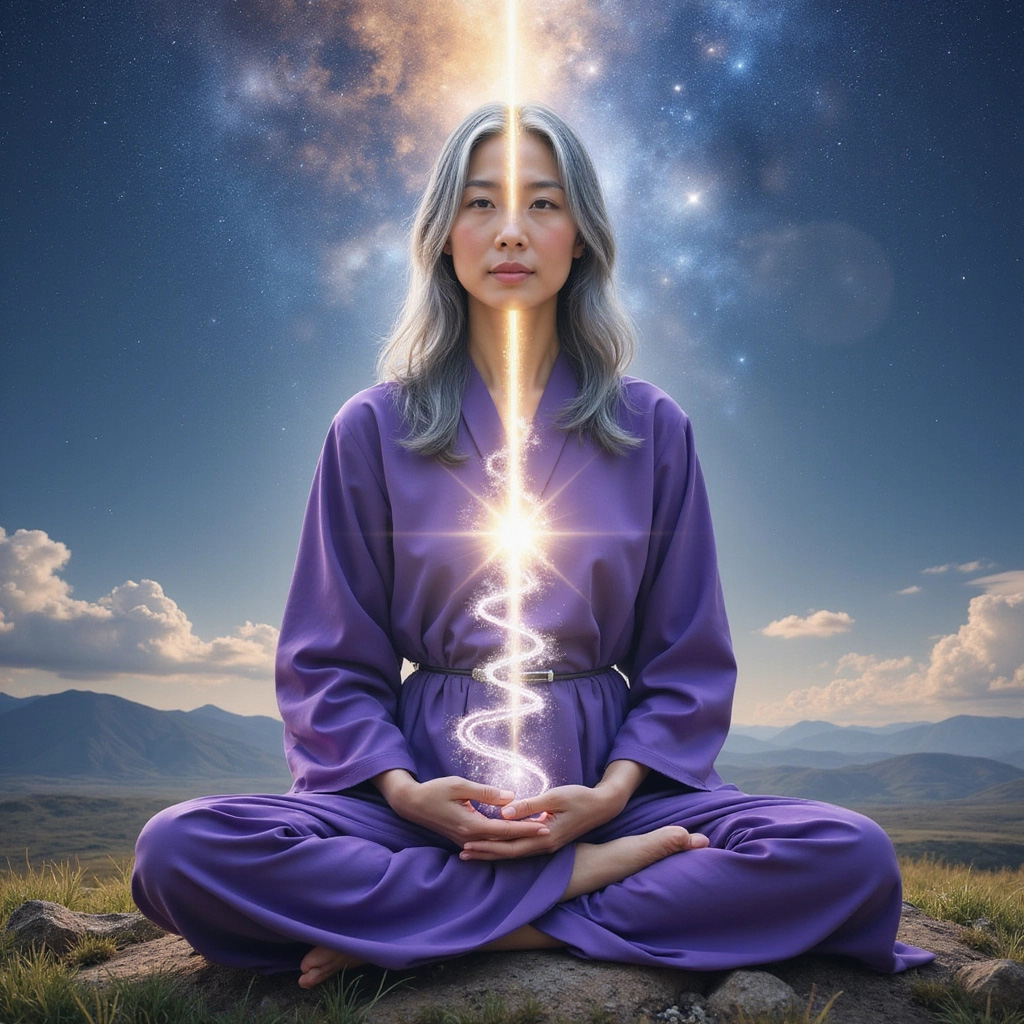
What Meditation Is Not
Reclaiming Bhāvanā as a Living Practice
By Roshi Teja Fudo Myoo
Before We Begin
Years ago, during a retreat, a student approached me during a walking period. We had been sitting, standing, and moving through a simple sequence of practice, really nothing elaborate, nothing dramatic. She looked thoughtful, a little uncertain.
After a pause, she said,
“I think I’m doing it wrong. My mind was busy the whole time.”
I asked her where she had felt the practice.
She gestured toward her chest.
“I could feel my breath more. I felt my feet on the floor. I noticed when I was pushing.”
We stood there quietly for a moment.
Then I said,
“That sounds like meditation to me.”
She laughed, half relief, half surprise.
“No one ever told me that counted.”
That moment has stayed with me.
Again and again, I meet people who are deeply present, sincerely engaged, and quietly cultivating awareness, yet convinced they are failing because their experience doesn’t match an image of what meditation is supposed to look like.
This chapter is offered for them.
And perhaps, in some way, for all of us.
Why So Many People Feel They’re “Bad at Meditation”
Over the years, I have met countless sincere practitioners who arrive with the same quiet confession, often spoken in a lowered voice, as if admitting a personal failure:
“I’m not very good at meditation.”
Some tell me their minds won’t settle.
Some say they can’t stop thinking.
Some feel restless, sleepy, anxious, or overwhelmed.
Others confess that meditation actually makes them feel worse, not better.
What touches me most is not the difficulty itself, but the assumption beneath it, the belief that meditation is something you either succeed at or fail at.
From a QigongDharma perspective, this belief is not only inaccurate; it is unnecessary suffering layered onto an already tender human experience.
Most people are not bad at meditation.
They are simply practicing without a clear understanding of what meditation actually is, what it is meant to cultivate, and how different forms of contemplative practice serve different functions.
In modern culture, the word meditation has been stretched so thin that it now encompasses everything from stress reduction and relaxation to peak mystical states, emotional healing, and spiritual awakening. When a single word is asked to carry so many meanings, confusion is inevitable.
Imagine calling stretching, strength training, cardiovascular conditioning, dance, and physical therapy all by the same name, and then wondering why your “exercise practice” doesn’t feel right.
The issue is not effort. It is orientation.
QigongDharma begins from a different question.
Not, “Am I doing this right?”
But rather, “What qualities of body, breath, mind, energy, and spirit are being cultivated here?”
Before we can answer that question honestly, we need to clear away some very common misunderstandings.
What Meditation Is Not
Meditation is not about forcing the mind to stop thinking.
Thoughts arise because the mind is alive. Expecting them to disappear is like asking the heart to stop beating or the lungs to stop breathing. When meditation is approached as mental suppression, it quickly becomes an exercise in frustration, judgment, and subtle self-aggression.
Meditation is not about achieving a special state and then holding onto it.
Peaceful states, expansive states, luminous states, these may arise, and they can be deeply nourishing. But when meditation becomes state-chasing, practice quietly turns into another form of grasping. QigongDharma reminds us that states come and go. Capacity, coherence, and integration are what endure.
Meditation is not about escaping the body.
Many people unconsciously try to meditate away from sensation, emotion, or discomfort. They float above experience, dissociating rather than integrating. While this can feel temporarily relieving, it is not true cultivation. Authentic contemplative practice fully includes the body, its weight, breath, textures, and rhythms. Awakening is not disembodiment. It is inhabitation.
Meditation is not always calming.
This is one of the most important clarifications. As awareness deepens, we often begin to feel what we have been holding at bay: grief, fear, anger, fatigue, and longing. This does not mean the practice is failing. It means the practice is working honestly. In QigongDharma, we learn how to regulate, pace, and support this unfolding rather than force ourselves through it.
Meditation is not one-size-fits-all.
Different constitutions, histories, nervous systems, and life circumstances require different doorways. A practice that stabilizes one person may dysregulate another. A form that awakens insight for one may feel barren or inaccessible to someone else. True practice respects timing, context, and individual capacity.
Meditation is not separate from how we live.
If our formal practice cultivates calm but our daily life reinforces speed, contraction, and disconnection, something essential is missing. From a QigongDharma perspective, meditation is not confined to a cushion or a schedule. It reveals itself in how we stand, how we walk, how we breathe under pressure, and how we meet the ordinary moments of our lives.
Most importantly, meditation is not a performance.
There is no ideal meditator to imitate, no internal scoreboard to consult. Practice is not about becoming someone else. It is about becoming intimate with what is already here and learning to relate to it wisely, kindly, and skillfully.
When meditation is understood as Bhāvanā, cultivation, development, the calling forth of latent capacities, a great deal of unnecessary struggle falls away. We stop asking, “Why can’t I meditate like them?” and begin asking, “What is being cultivated through this practice, in this body, at this time?”
That shift alone is often enough to transform discouragement into curiosity, and effort into listening.
Meditation as Bhāvanā: Cultivation Rather Than Performance
When meditation is understood as Bhāvanā, something subtle yet profound changes the way we practice.
Bhāvanā means cultivation, the careful, patient development of capacities that already exist in seed form. Just as a gardener does not command a plant to grow, contemplative practice does not force awakening to occur. Instead, it creates the conditions in which growth becomes natural.
This understanding frees us from the idea that meditation is something we “do” to ourselves.
It is not an act of control, achievement, or self-improvement.
It is an ongoing relationship with our own unfolding.
From a QigongDharma perspective, Bhāvanā always involves the whole being:
- the body, with its tensions and ease
- the breath, with its rhythms and intelligence
- the mind, with its patterns and insights
- the energetic field, with its flow or congestion
- the spirit, with its innate orientation toward wholeness
Meditation, then, is not a single activity but a family of practices, each cultivating different aspects of our human potential.
Some practices stabilize us.
Some clarify perception.
Some soften the heart.
Some strengthen attention.
Some dissolve long-held patterns in the nervous system.
Some open us into vastness and non-separation.
None of these are superior to the others. They are contextual responses, appropriate to where a practitioner is and what is needed now.
Confusion arises when we expect one form of meditation to do everything, or when we judge a practice by a function it was never meant to serve.
Bhāvanā invites a wiser question:
What is this practice cultivating?
Once we ask that question sincerely, the diversity of contemplative practices begins to make sense.
Many Practices, Many Functions: A Clarifying View
Seen through the lens of cultivation, meditation is no longer a single road but a landscape. Different paths move through different terrain, and mature practice involves learning when to walk, when to rest, and when to let the path walk us.
When we stop comparing practices hierarchically and instead look at their functions and effects, clarity naturally arises. Meditation reveals itself as a responsive art rather than a fixed method.
Letting the Five Regulations Reveal Themselves
From this landscape, a deeper coherence begins to emerge.
Every genuine contemplative practice, no matter how still or dynamic, simple or subtle, is working with regulation.
Not regulation as control or discipline imposed from above, but regulation as harmonization, the natural re-ordering of the human system when it is listened to wisely.
In QigongDharma, this harmonization expresses itself through the Five Regulations:
Body, Breath, Mind, Energy, and Spirit.
These are not stages to complete or compartments to manage. They are dimensions of a single living process, always interacting, always informing one another.
As practice matures, meditation ceases to feel rigid. It becomes responsive, adaptive, and alive.
We no longer ask, “Which meditation is the best?”
We ask, “Which regulation is being supported right now, and which one is asking for attention?”
That question alone transforms practice from repetition into listening.
The Seven Factors of Awakening as a Natural Flowering
When the Five Regulations are tending one another in balance, something remarkable occurs. The qualities described in the Buddhist tradition as the Seven Factors of Awakening begin to arise, not because we force them to, but because the conditions are present.
Mindfulness appears as embodied presence.
Investigation arises as curiosity rather than analysis.
Energy becomes steady and sustainable.
Joy shows itself as quiet gladness, not excitement.
Tranquility settles the system without dullness.
Concentration stabilizes without rigidity.
Equanimity reveals itself as deep balance and care.
From a QigongDharma perspective, these factors are not goals to achieve. They are signals of integration, felt indicators that practice is aligned with the natural intelligence of awakening.
Meditation as a Way of Living
When meditation is reduced to a single technique or posture, it inevitably becomes narrow. When it is understood as Bhāvanā, cultivation across body, breath, mind, energy, and spirit, it becomes vast, flexible, and deeply humane.
From this view, meditation is not confined to silence or stillness. It includes:
- standing with awareness
- moving with presence
- breathing through difficulty
- meeting others with clarity and care
- resting in what is, just as it is
QigongDharma does not ask us to choose between ancient wisdom and modern life, between movement and stillness, or between insight and embodiment. It invites us to practice in a way that embraces the whole of who we are.
Meditation, then, is not something we do for a few minutes a day.
It is something we become fluent in, moment by moment, breath by breath, step by step.
This is the heart of cultivation.
This is the living meaning of Bhāvanā.
Living the Question
If there is one invitation at the heart of this exploration, it is not to adopt a new technique, but to live a new question.
Not:
Am I meditating correctly?
But:
What is being cultivated here?
When we ask that question sincerely, practice becomes responsive rather than rigid. We begin to listen, to the body’s need for grounding, to the breath’s natural intelligence, to the mind’s patterns and insights, to the energy moving through us, and to the heart’s deeper orientation.
Meditation ceases to be something we perform to become someone else. It becomes a way of being with what is and allowing it to mature.
Some days, cultivation looks like stillness.
Some days, it looks like movement.
Some days, it looks like inquiry.
Some days, it looks like rest.
All of it belongs.
QigongDharma reminds us that awakening is not separate from living. It is revealed in how we stand, how we breathe, how we meet difficulty, and how we return, again and again, to presence.
Meditation, understood as Bhāvanā, is not a destination.
It is a relationship.
And like all living relationships, it grows through attention, patience, and care.