

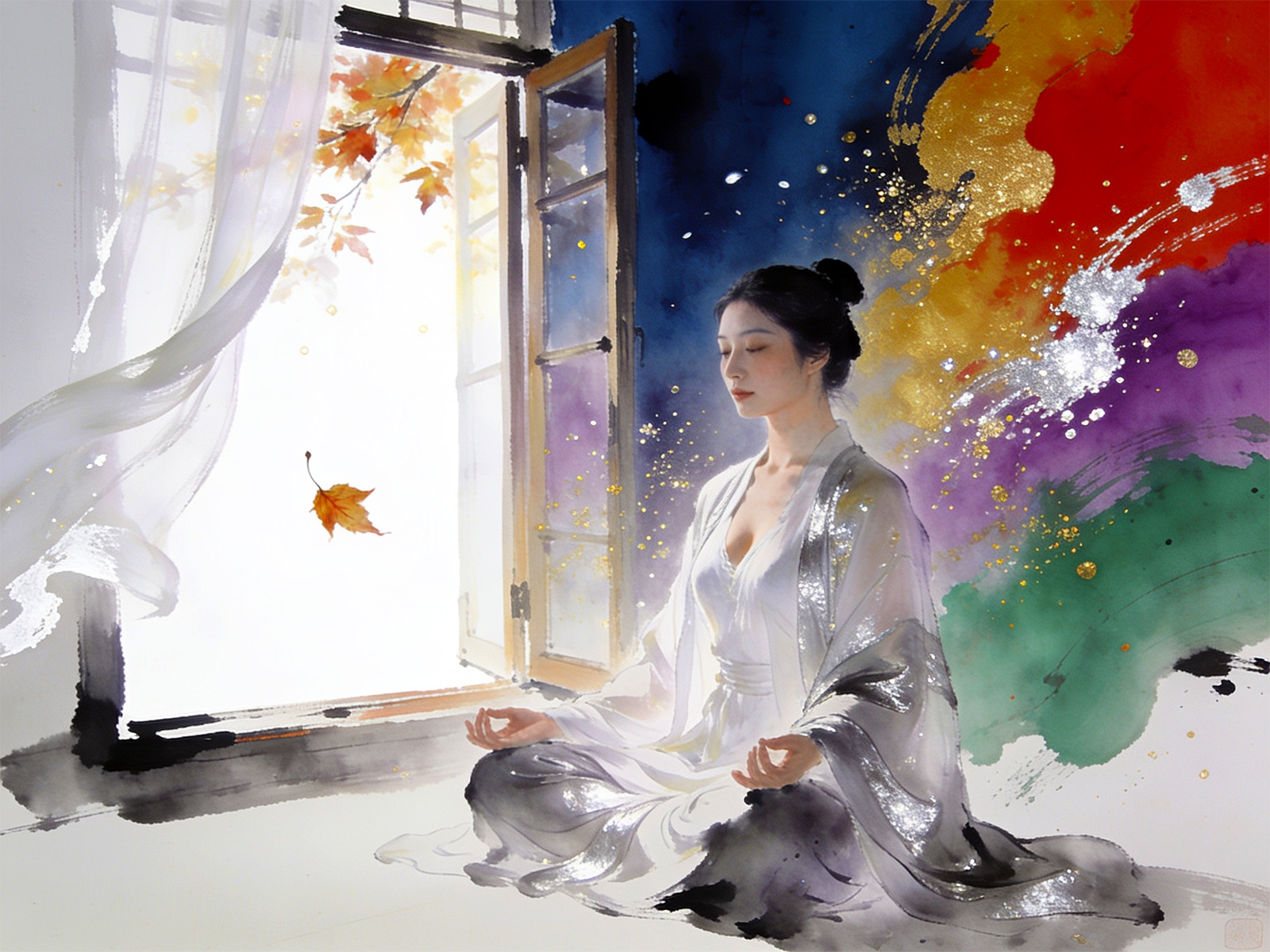
🍂 Letting Go, Becoming Whole 🍂
A QigongDharma Daylong Retreat
Autumnal Equinox · Metal Element · Integration & Release
Refinement through Simplicity
September 19, 2026
Subud Center, San Anselmo, CA
10:00 AM – 3:00 PM
with Roshi Teja Fudo Myōō Bell
Opening Reflection
Autumn arrives differently from Summer.
There is still warmth in the afternoon, still fruit on the branch, still light pouring across the hills. But something has already turned.
The mornings are quieter.
The shadows lengthen.
Leaves begin to loosen their grip.
The year is not dying. It is becoming simple.
Autumn teaches us the wisdom of less.
Not deprivation.
Not rejection.
Not spiritual austerity.
Refinement.
The tree does not consider each leaf a failure when it lets it go. The field does not mourn the grasses because they have completed their season. Nothing in Autumn is hurrying to get rid of itself.
The release comes because the time has come.
This is very different from forcing ourselves to let go.
In QigongDharma, letting go is not something we do to ourselves. It becomes possible when we have listened deeply enough to know what has completed its work.
The Metal Element offers this kind of discernment.
Metal is associated with clarity, value, refinement, and preciousness. It asks:
What is essential?
What still belongs?
What can be laid down now?
And perhaps the deeper question:
Who am I when I no longer carry everything I have carried?
Autumn invites us into this inquiry without urgency.
We breathe in. We receive.
We breathe out. We release.
And somewhere between receiving and releasing, we discover that emptiness is not the opposite of wholeness.
Sometimes emptiness is what allows wholeness to appear.
What the Tree Knows
The tree does not call it
‘letting go.’
It simply knows
when the leaf
has finished being green.
No argument.
No ceremony.
One morning
the branch is lighter,
and the earth
has received
what the sky
no longer needs to hold.
Perhaps this is why
the trees are so quiet.
They have been practicing
impermanence
longer than we have
Flow of the Day
This schedule sets the general rhythm while remaining responsive to the needs of the group.
9:30 – 10:00 AM · Arrival, check-in, tea, and settling
A quiet arrival into the hall, the body, the breath, and the changing season.
10:00 – 10:30 AM · Opening circle: orientation, intention setting, and taking refuge
Entering the Autumn mandala through presence, simplicity, and the willingness to listen for what is essential.
10:30 – 11:30 AM · Morning Qigong and DaoYin: Metal Element practices
Breath-centered movement, opening the chest and upper back, gentle spirals through the ribs, lungs, arms, and hands, and practices emphasizing receiving, releasing, and refinement.
11:30 – 11:45 AM · Silent break for tea, reflection, or quiet walking
A pause to let the movement settle and the breath return to itself.
11:45 AM – 12:15 PM · Dharma teaching: “Letting Go, Becoming Whole”
The Metal Element, grief and preciousness, essentialization, the breath as bridge between form and formlessness, and release as active wisdom.
12:15 – 1:00 PM · Lunch break and community connection
An invitation to eat in silence, conversation, or quiet companionship according to one’s own needs.
1:00 – 1:30 PM · Guided sitting meditation: Receiving and Releasing
Resting with the natural rhythm of the breath and allowing the body to experience release without force.
1:30 – 2:10 PM · Afternoon Qigong: Refinement through Simplicity
Simple forms practiced more deeply: less movement, more listening; less effort, more coherence; less accumulation, more essence.
2:10 – 2:35 PM · Dialogue, inquiry, and reflection in community
What is essential now? What has completed its work? What does dignity in letting go feel like in the body?
2:35 – 2:45 PM · Closing practice and dedication of merit
Settling the heart, gathering the qi, and dedicating the goodness of the day.
2:45 – 3:00 PM · Priesthood Ordination of Alejandro Anastasio
Roshi Teja Fudo Myōō will conduct the priesthood ordination of Alejandro Anastasio. This brief ceremony is open to everyone, and all are warmly welcome to remain and witness this threshold in practice and service.
Autumn as Seasonal Intelligence
The Autumn Equinox gives us another moment of balance.
Day and night meet almost equally.
But, as in Spring, the balance does not remain fixed.
The world turns.
Light begins yielding to darkness. Sap draws inward. Leaves change color because the tree has begun reclaiming what can be saved and releasing what no longer needs to be held.
This is not withdrawal in the ordinary sense.
It is intelligence.
Autumn knows that life cannot remain in constant expansion.
Summer opens outward. Autumn gathers inward.
Summer celebrates abundance. Autumn asks what among that abundance truly matters.
This is the movement of refinement.
In practice, we often imagine growth as accumulation.
More techniques.
More experiences.
More insight.
More teachings.
More capacity.
More accomplishment.
For a time, this is natural. We learn by gathering.
But eventually practice turns.
We begin to discover that maturity is not measured by how much we have collected.
It is revealed in how little we require.
A mature practitioner may appear simpler than a beginner.
The breath becomes simpler.
The posture becomes simpler.
The movement becomes simpler.
The teaching becomes simpler.
And yet this simplicity contains more.
Autumn teaches us that reduction is not diminishment.
It is concentration.
The unnecessary falls away so the essential can become visible.
The Metal Element
Clarity, Value, and Preciousness
Metal carries the quality of refinement.
Ore is drawn from the earth and purified through fire. Impurities are removed. What remains becomes useful, strong, bright, and clear.
There is a similar process in spiritual practice.
We begin with everything mixed together.
Our aspirations and our fears.
Our love and our grasping.
Our discipline and our ambition.
Our generosity and our need to be appreciated.
Our insight and the stories we still tell about ourselves.
This is completely human.
Practice does not require purity before we begin.
Practice is the refining.
Over time, the question changes from:
How can I become more?
to:
What is actually true?
This is the gift of Metal.
Metal cuts cleanly. Not cruelly. Clearly.
It allows us to distinguish what is essential from what is merely familiar.
This can be uncomfortable.
We may discover that certain roles we have carried no longer fit.
Some habits have completed their usefulness.
Some ambitions have quietly become burdens.
Some identities that once protected us now limit us.
And sometimes what we are being asked to release is not bad at all.
It may have been beautiful. Necessary. Even sacred.
Autumn teaches us that something does not have to be wrong before we are allowed to let it go.
Sometimes it is simply complete.
The Precious Thing
I thought I had to carry
the whole house with me—
every room,
every photograph,
every unfinished conversation.
Then Autumn came
with empty hands.
It asked only:
What do you love?
Not what do you possess.
Not what do you fear losing.
What do you love?
I stood there
for a long time.
Then something
very small
remained.
And it was enough.
Letting Go as Active Wisdom
We often speak casually about letting go.
“Just let it go.”
As though the heart were a hand that had simply forgotten to open.
But genuine release is rarely that simple.
Some things are held because they still need to be felt.
Some things are held because they have not yet been understood.
Some things remain because a part of us is still protecting something precious.
So in QigongDharma, letting go is not an instruction imposed from above.
It is an intelligence that ripens from within.
The body knows this.
A muscle cannot truly release because someone tells it to relax.
It releases when sufficient conditions are present.
Safety.
Support.
Awareness.
Time.
The same is true of emotional life.
We cannot command grief to leave.
We cannot order memory to disappear.
We cannot force forgiveness into being.
We create conditions in which what has been held can begin to move again.
Then release may come.
Not as rejection.
As completion.
This is why letting go is active wisdom.
It requires discernment.
It requires courage.
And sometimes it requires the deeper courage to discover that we are not ready yet.
That too is wisdom.
Autumn does not shake every leaf from the tree at once.
Each leaf releases in its own time.
Grief as Love Completing Itself
Grief belongs naturally to Autumn.
Not because Autumn is sad, but because Autumn reveals the intimacy between love and impermanence.
We grieve because something mattered.
A person.
A place.
A season of life.
A capacity of the body.
A relationship.
A dream.
A version of ourselves we once inhabited.
Grief is not evidence that practice has failed.
It is evidence that the heart has participated.
There are forms of spirituality that subtly teach us to rise above grief, detach from grief, witness grief from some supposedly superior place.
There can certainly be wisdom in spacious awareness.
But grief also deserves to be lived from inside the body.
It has its own breath.
Its own rhythm.
Its own timing.
Sometimes grief moves as tears.
Sometimes as silence.
Sometimes as fatigue.
Sometimes as gratitude so strong that the body cannot distinguish it from sorrow.
And sometimes grief is very quiet.
It simply sits beside us.
In Autumn practice, we do not rush grief toward resolution.
We listen.
We let grief reveal what has been precious.
And perhaps this is one of its deepest teachings:
Grief is love learning how to continue when form has changed.
The relationship does not necessarily disappear.
Its form changes.
The breath changes.
The body changes.
The season changes.
Love learns another shape.
After the Bell
The bell has stopped ringing,
but something
is still moving
through the room.
We call this silence.
But it is not empty.
The bell is here
in another form—
inside the wood,
inside the walls,
inside the body
that heard it.
Perhaps grief
is like this.
The sound has changed,
but the listening
continues.
Breath: The Bridge Between Form and Formlessness
Autumn is traditionally associated with the lungs.
This makes immediate sense when we enter the practice through the breath.
Every breath teaches the whole dharma.
Receiving.
Releasing.
Receiving.
Releasing.
We cannot inhale forever.
We cannot exhale forever.
Life depends upon participation in both movements.
The inhalation gathers form.
The exhalation returns it.
And between them there are small thresholds where neither receiving nor releasing needs to be forced.
For a brief moment, the breath rests in itself.
The lungs are extraordinary teachers of impermanence because they never confuse holding with living.
They receive completely.
Then they release completely.
And they trust another breath to come.
Imagine living like this.
Not carelessly.
Not without memory.
But without trying to store every moment inside ourselves.
We meet experience.
We receive what nourishes.
We release what has completed its passage.
Then we meet the next breath.
This is why breath practice in Autumn can become very quiet.
We do not need elaborate manipulation.
We simply become intimate with the natural exchange already occurring.
The whole world enters.
The whole world leaves.
And still, somehow, here we are.
The Practice Today
Our movements today will reflect Autumn’s intelligence.
There may be less external movement than in Summer.
We will explore opening and closing through the chest, ribs, shoulders, arms, and hands.
We will allow the lungs to breathe three-dimensionally through the front body, side ribs, back ribs, and spaces beneath the shoulder blades.
We will work with gestures of gathering and release.
Drawing in.
Settling.
Opening.
Offering.
Returning.
But the central instruction will remain simple:
Do not force the release.
Instead, notice where effort has completed itself.
Let the movement finish.
Let the breath finish.
Let the gesture finish.
One of the great disciplines of Qigong is learning not to add another movement when the movement is already complete.
This is much harder than it sounds.
The mind enjoys continuation.
It likes improvement.
It says:
Perhaps one more repetition.
Perhaps a little deeper.
Perhaps a little stronger.
Autumn says:
Enough.
There is enormous dignity in enough.
Refinement Through Simplicity
The deeper we go into practice, the less decoration is required.
At first, movement helps us find qi.
Eventually, stillness reveals movement.
At first, the breath is something we attend to deliberately.
Eventually, breath and awareness are no longer separate.
At first, we regulate the body.
Eventually, the body teaches us regulation.
This is the movement from method toward embodiment.
Refinement is not making ourselves smaller.
It is becoming less divided.
What remains after unnecessary effort falls away is often remarkably simple.
Standing.
Breathing.
Listening.
Receiving.
Releasing.
Nothing spectacular.
And yet the entire path can be found there.
Enough
One cup.
One breath.
One branch
against the Autumn sky.
For years
I thought awakening
would add something.
Then the leaves
began to fall.
Essentialization
There comes a time in every serious practice when we must ask what is essential.
Not theoretically. Actually.
What practices truly sustain us?
What relationships invite honesty?
What commitments still carry life?
What ways of spending our attention leave us clear?
What ways leave us scattered?
Essentialization is not minimalism as style.
It is discernment as practice.
We do not simplify life so that it looks clean.
We simplify so that energy becomes available for what matters.
The same is true in Qigong.
If ten movements are useful, practice ten.
If three are enough, practice three.
If one posture contains the whole teaching today, stay there.
This principle can extend into speech.
Can fewer words carry more truth? Into work.
Can fewer activities carry more meaning? Into relationship.
Can we stop performing connection and simply become available?
Autumn keeps asking:
What remains when excess falls away?
That question is not bleak.
It is liberating.
Because what remains is usually what we have loved all along.
Guided Meditation
Receiving and Releasing
Let the body settle.
Feel the weight of the body descending.
Feel the support beneath you.
There is nowhere else to arrive.
Let the breath come by itself.
Notice the inhalation.
You do not have to pull it in.
The body knows how to receive.
Notice the exhalation.
You do not have to push it out.
The body knows how to release.
Receiving.
Releasing.
Let the shoulders settle.
Let the jaw soften.
Feel the movement of the ribs.
Perhaps the back of the body can breathe a little more.
With each inhalation:
Receiving what is here.
With each exhalation:
Releasing what has completed itself.
No need to name what is leaving.
No need to improve the moment.
Simply participate in the exchange.
If grief is present, let grief breathe.
If gratitude is present, let gratitude breathe.
If nothing particular is present, let that be enough.
Notice the quiet threshold after the exhalation.
Nothing held.
Nothing missing.
Then the next breath arrives.
Rest here.
Breath after breath,
the body practicing impermanence
without calling it impermanence.
Three Autumn Questions
What is Essential?
If I could carry only what truly matters into the next season of my life, what would remain?
What Has Completed Its Work?
What am I still carrying because it is familiar rather than alive?
What Does Dignified Release Feel Like?
Can I recognize the bodily difference between rejecting something and allowing it to complete?
These are not questions requiring immediate answers.
Autumn questions are good companions.
Carry them gently.
Let the season answer.
Living the Practice in Daily Life
The practice of release does not require dramatic change.
It happens in very ordinary moments.
When you finish a conversation and do not continue it internally for another hour.
When the email has been sent and you let it be sent.
When you put down the cup.
When the exhalation ends.
When you say no without constructing a courtroom argument to justify it.
When you say yes without adding resentment afterward.
When you clean a drawer.
When you forgive yourself for having been younger.
When you realize that a role you once played beautifully is no longer yours to play.
When you leave a little empty space in the day.
These are small acts of Autumn.
Each one says:
I trust life enough not to hold every form forever.
The Empty Bowl
After the meal
the bowl is empty.
No tragedy.
No philosophy.
It has simply
done its work.
Washed clean,
it waits upside down
beside the sink,
holding nothing,
missing nothing.
Becoming Whole
There is a paradox hidden in the title of this retreat.
Letting Go, Becoming Whole.
We usually imagine wholeness as acquisition.
Gathering all our parts.
Healing every wound.
Recovering everything lost.
Becoming complete.
But perhaps wholeness is not something we assemble.
Perhaps wholeness becomes visible when we stop carrying what obscures it.
A tree in Autumn is not less of a tree because the leaves have fallen.
In some ways, we see its form more clearly.
The branches appear.
The trunk reveals itself.
The architecture that Summer concealed becomes visible against the sky.
This too is practice.
The structures beneath personality begin to appear.
Kindness.
Presence.
Awareness.
Integrity.
Love.
Not sentimental love.
The love that remains when the story has quieted.
The love that can include grief.
The love that does not need everything to stay.
Priesthood Ordination
A Threshold of Release and Commitment
At the close of today’s retreat, we will enter another kind of Autumn threshold.
At 2:45 PM, I will conduct the priesthood ordination of Alejandro Anastasio.
All are welcome to remain and witness.
Ordination is itself a practice of refinement.
It is not simply acquiring a title or adding an identity.
In its deeper meaning, ordination is a letting go.
A letting go into vow.
A letting go into service.
A willingness to allow one’s life to become increasingly transparent to the Dharma.
The ceremony is brief.
The vow is not.
There is something especially fitting about offering this ordination within the Autumn mandala.
Metal asks what we value.
Ordination asks the same question with a life.
What is precious enough to serve?
What is essential enough to vow oneself toward?
What can be released so that service becomes clearer?
Those who stay are not merely spectators.
We become witnesses.
And in Buddhist practice, witnessing matters.
A vow spoken before others becomes part of the shared field of practice.
We help hold it.
The community quietly says:
We heard you.
We saw you step across.
May your life embody what you have vowed.
Closing Dedication
As we come toward the close of our practice, we recognize what has been shared here.
Whatever clarity has arisen.
Whatever tenderness.
Whatever release.
Whatever remains unresolved.
We include all of it.
Nothing has to be completed before we dedicate the goodness of practice.
May what has become clearer today continue to clarify.
May what is ready to fall away do so without violence.
May what still needs holding be held with tenderness.
May grief reveal what has been precious.
May the breath teach us receiving and releasing.
May simplicity reveal abundance.
May we learn the dignity of enough.
And as we move toward the darker half of the year, may we remember that darkness is not the absence of life.
Much of life grows inward before it appears again.
We dedicate the goodness of this day to those we love, to those we have lost, to those we find difficult to love, and to all beings everywhere who are carrying what feels too heavy.
May all beings discover what can be laid down.
May all beings recognize what is essential.
May all beings know the freedom of a heart that can hold and release.
Autumn Blessing
May what is finished
finish.
May what remains
become clear.
May grief
open the hidden door
where gratitude
has been waiting.
May your hands
learn the wisdom
of opening.
May your breath
remember
that release
is part of receiving.
And when the branch
finally becomes bare,
may you discover
the sky
was there
all along.
Seasonal Vow
I will listen for what is essential.
I will not force release before its time.
I will honor what has been precious,
and allow what is complete to complete.
I will let the breath teach me
how to receive
and how to let go.
I will practice simplicity
not as deprivation,
but as clarity.
I take refuge in the wholeness
that remains
when excess falls away.
The Living Mandala of the Year
This retreat continues the four-season cycle of QigongDharma practice:
Spring · Awakening the Living Current
Growth · Direction · Wood
Summer · Abiding in the Radiant Heart
Joy · Connection · Fire
Autumn · Letting Go, Becoming Whole
Integration · Release · Metal
Winter · Resting in Source
Stillness · Restoration · Water
Each retreat stands complete on its own.
Together, they reveal another rhythm.
We awaken.
We radiate.
We refine.
We return.
Nothing is excluded.
Nothing is wasted.
The whole year is practice.
A Note for Those Who Have Difficulty in the Body
These practices are offered with awareness that many of us carry unresolved stress, grief, or trauma in our bodies. For some, turning attention inward can feel uncomfortable or even activating. If this is your experience, please know:
- You are always invited to modify, pause, or step back from any practice.
- Keeping the eyes slightly open, feeling the feet on the floor, or orienting to the room can help maintain a sense of safety and grounding.
- It is not necessary to relax deeply to benefit from these practices. Simply showing up and practicing within your window of tolerance is enough.
- Gentleness is not a preliminary stage on the way to ‘real’ practice. Gentleness is real practice.
The body heals at its own pace, in its own way. Our task is to create conditions of safety and support, and then to trust the process.